13 December 2025
Bahrain Authority for Culture and Antiquities Participates in the Opening of Zayed National Museum, Showcasing 19 Artefacts from the Dilmun and Tylos Periods
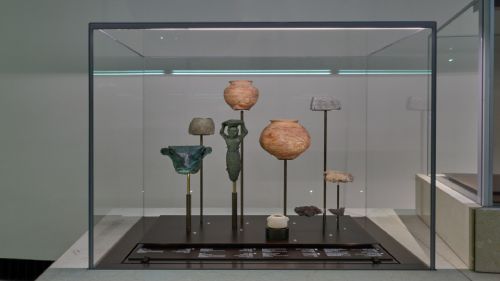
The Bahrain Authority for Culture and Antiquities participated in the official opening of Zayed National Museum in Abu Dhabi, as part of the ongoing cultural collaboration between the Kingdom of Bahrain and the United Arab Emirates. The Authority was represented at the ceremony by Dr. Salman Ahmed Almahari, Director General of Archaeology, and Ms. Haya Ahmed Al Sada, Director of Museums.
On this occasion, the Bahrain National Museum loaned 19 distinguished archaeological artefacts from the Dilmun and Tylos civilisations, carefully selected to represent Bahrain’s rich heritage within the exhibition galleries of Zayed National Museum. The loaned collection includes pottery, copper, and steatite vessels, Dilmun seals, locally minted Greek silver tetradrachm coins, as well as glass vessels dating to the Tylos period. This collection represents the largest Bahraini loan to a museum institution outside the Kingdom during this period, reflecting the significance of the Bahrain National Museum and the richness of its collections.
On this occasion, H.E. Shaikh Khalifa bin Ahmed bin Abdullah Al Khalifa, President of the Bahrain Authority for Culture and Antiquities, highlighted the importance of the collaboration between the two institutions. He noted that the number of artefacts loaned to Zayed National Museum is the largest of its kind during this period, underscoring the depth of cultural ties between the Kingdom of Bahrain and the United Arab Emirates, as well as the shared commitment of both countries to presenting the region’s history and civilisations at regional and international levels. He further emphasised that Bahrain’s participation in the opening of Zayed National Museum reflects its dedication to strengthening Gulf cultural presence and reinforcing the role of museums in preserving heritage, documenting regional history, and making it accessible to global audiences.
A Memorandum of Understanding between Zayed National Museum and the Bahrain National Museum was signed earlier this year, aiming to enhance cultural and museological coordination, exchange expertise, and develop specialised programmes in conservation, preventive preservation, visitor services, museum education, and exhibition development. The Memorandum also provides for the implementation of joint cooperation programmes, the organisation of collaborative exhibitions, the exchange of collections, and the hosting of seminars, lectures, and cultural events, in addition to encouraging historical and scientific research that supports the study of the region’s history and heritage.