07 December 2025
Bahrain Authority for Culture and Antiquities Participates with Artworks from Its Collection in “Art Across the Arabian Gulf” Exhibition at Misk Art Institute in Riyadh
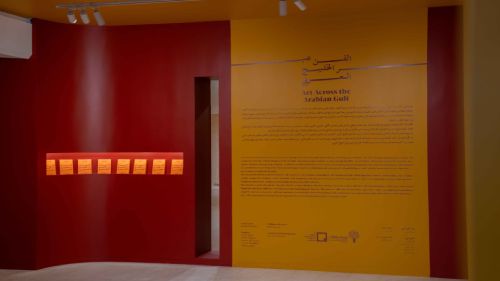
The Bahrain Authority for Culture and Antiquities participated with a selection of artworks from the Bahrain National Museum’s collection in the exhibition “Art Across the Arabian Gulf,” organised by the Misk Art Institute, part of the Mohammed bin Salman Foundation. The exhibition is being held at the Prince Faisal bin Fahd Hall for Fine Arts in Riyadh, from 5 November 2025 to 31 March 2026.
The “Art Across the Arabian Gulf” exhibition saw the distinguished presence of Bahraini visual art pioneers who played a significant role in shaping the development of the art movement through its various stages. Their artistic and intellectual visions became a lasting influence over the decades, contributing to the documentation of their artistic journeys that express the shared Gulf identity in fine art.
Among them is Abdullah Al Muharraqi, whose artistic practice encompassed painting, caricature and design, blending surrealist and cubist influences with decorative elements inspired by Gulf and Bahraini folklore and maritime traditions rooted in Bahraini authenticity.
The late Ahmed Baqer is represented through dynamic pencil and ink studies that began with explorations of human anatomy, light, shadow and movement, emphasising expressive lines and strong contrasts. As his practice evolved, his style turned towards abstraction, combining his academic background with a focus on simple and symbolic forms.
The late Hussain Al Sunni, drawing on his academic background and ongoing engagement with Bahrain’s cultural life, portrayed scenes of traditional crafts and the local environment — such as boatbuilders and divers — using free brushstrokes and rhythmic compositions. By the 1970s and 1980s, his work had turned towards abstraction, combining elements of Arabic calligraphy with flat colour areas and symbolic shapes.
The late Abdul Karim Al Bosta followed a balanced path between faithfulness to heritage and openness to formal experimentation. His paintings depicted village life in Bahrain before moving towards abstraction and geometric compositions that integrated local ornamentation and Arabic calligraphy into a contemporary visual language.
The late Yousif Qassim practised an artistic approach that combined realism and social documentation, focusing on scenes from Bahraini life and heritage. He sought to record ways of life that were disappearing amid Bahrain’s rapid modernisation, highlighting the quiet expressions etched on the faces of elders and working-class individuals.
More than 70 pioneering artists from GCC countries participated in the exhibition, with 150 artworks reflecting key stages in the formation of modern art history from the 1950s to the 1990s. Together they embody a collective memory devoted to shaping national visual identities through passionate and complex artistic experiences that documented the narratives defining creativity and renewal.
The exhibition offers an open view into the world of visual arts through a comprehensive vision that reflects the diversity and richness of artistic culture in the Arabian Gulf.